Breathing Exercises at Home
Quick answer
Pursed-lip breathing and belly (diaphragmatic) breathing are the two techniques most often taught in pulmonary rehabilitation. They can help you slow your breathing and feel more in control when you are short of breath. Practice them for 5 to 10 minutes a day while your breathing is comfortable. They don’t treat or cure any lung condition, so check with a doctor first if you have one.
Breathing exercises are free, need no equipment and take only a few minutes. They won’t make your lungs bigger or repair damage, but they can help you use your breathing more efficiently and stay calmer when you feel breathless. This guide covers three techniques, step by step, plus the safety points to know first.
Practice along
Our free guided breathing exerciser paces you through slow breathing, pursed-lip breathing, box breathing and 4-7-8 breathing with an animated circle.
Before you start Breathing Exercises at Home: safety first
- Sit or lie somewhere comfortable, with your neck and shoulders relaxed.
- Breathe gently. Don’t force air in or out.
- Stop if you feel dizzy, light-headed, tingly or more breathless, and breathe normally.
- If you have COPD, asthma, a heart condition or another health problem, ask your doctor or a respiratory physiotherapist which techniques suit you, especially before trying breath-holding patterns.
- Breathing exercises are not a substitute for prescribed inhalers or other treatment.
When to get help now
Call 911 (US) or 999 (UK) for severe breathlessness, chest pain, coughing up blood, or blue or gray lips. See a doctor soon for a cough lasting more than 3 weeks, breathlessness doing normal things, or wheezing.
1. Pursed-lip breathing
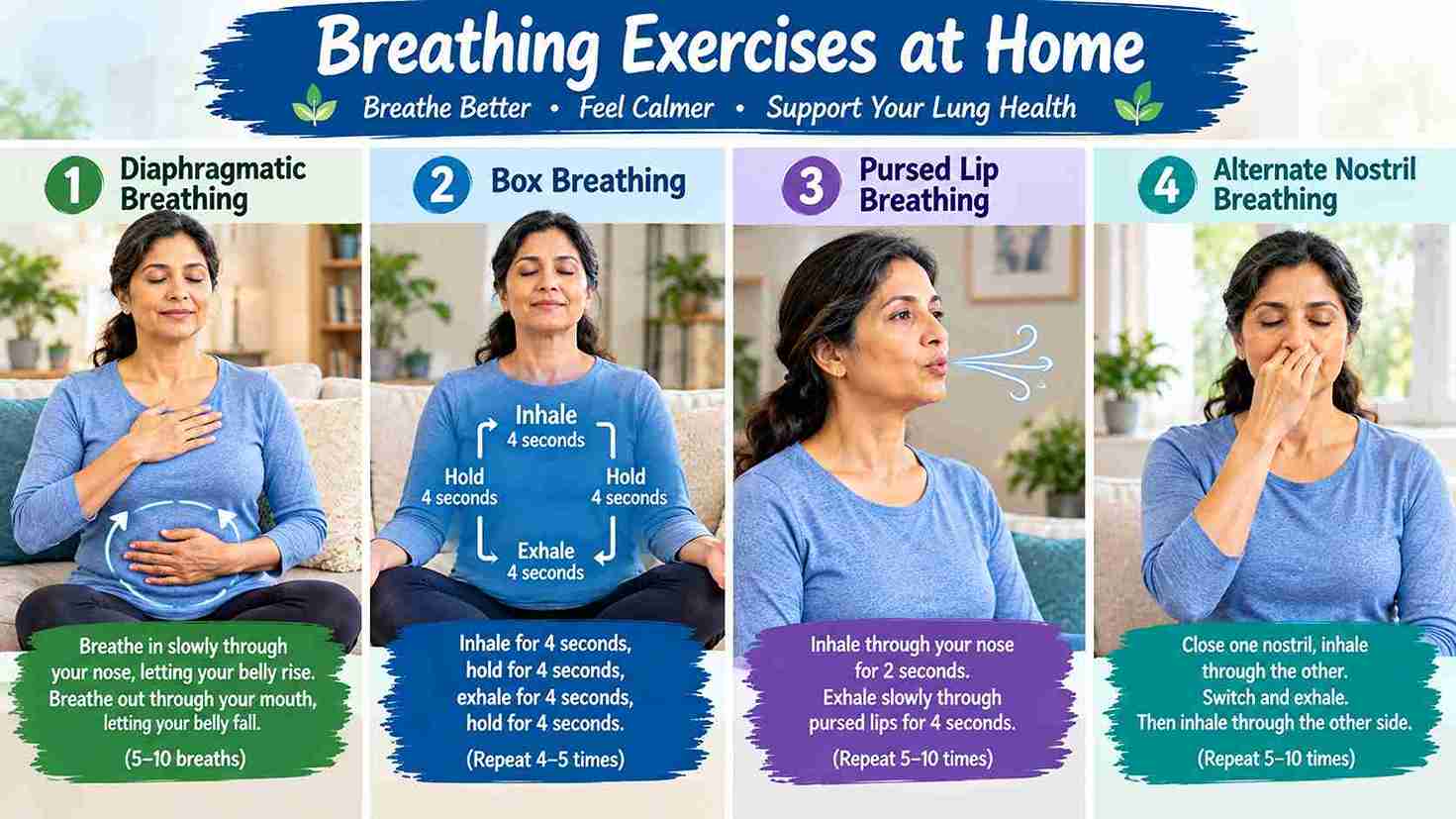
Pursed-lip breathing slows your breathing down and keeps your airways open a little longer as you breathe out, which can help move trapped air out of the lungs. The American Lung Association describes it as one of the two most useful techniques taught by pulmonary rehabilitation specialists.
How to do it
- Sit down and relax your neck and shoulders.
- Breathe in slowly through your nose for about 2 counts, with your mouth closed.
- Pucker your lips as if you were about to whistle or gently blow out a candle.
- Breathe out slowly and gently through your pursed lips for about 4 counts. Aim to breathe out at least twice as long as you breathed in.
- Repeat until your breathing feels calmer.
Many people use pursed-lip breathing during the harder part of an activity, such as climbing stairs or carrying shopping.
2. Belly (diaphragmatic) breathing
Your diaphragm, the dome-shaped muscle under your lungs, does most of the work of breathing. When breathing becomes difficult, people often start using the muscles of the neck, shoulders and upper chest instead. Belly breathing helps you retrain the diaphragm.
How to do it
- Sit comfortably or lie on your back with your knees bent.
- Place one hand on your upper chest and the other on your belly, just below your ribs.
- Breathe in slowly through your nose. Let your belly rise against your hand while your chest stays fairly still.
- Breathe out slowly through pursed lips, letting your belly fall.
- Repeat for a few minutes, keeping your shoulders relaxed.
Belly breathing takes practice and can feel awkward at first. The American Lung Association suggests practicing both exercises for 5 to 10 minutes a day when you are breathing comfortably, so they are familiar when you need them.
3. Box breathing
Box breathing is a popular relaxation technique: breathe in for 4, hold for 4, breathe out for 4, hold for 4. Some people find the steady rhythm calming. It is used mainly for stress and relaxation, and there is little research on it for lung health. Because it includes breath-holds, skip it or ask your clinician first if you have a lung or heart condition. Slow breathing (in for 4, out for 6) is a gentler alternative with no holds.
What can breathing exercises do?
| Can help with | Can’t do |
|---|---|
| Slowing your breathing and helping you feel calmer | Cure or reverse COPD, asthma, emphysema or any other disease |
| Easing the feeling of breathlessness during activity for some people | Repair lung damage or “detox” your lungs |
| Using your breathing muscles more efficiently | Replace inhalers, oxygen or other prescribed treatment |
| Giving you something to do in the moment when breathlessness feels scary | Increase the size of your lungs |
Pulmonary rehabilitation: the bigger picture
If you have a long-term lung condition, the best place to learn these techniques properly is a pulmonary rehabilitation program. These supervised programs combine exercise training, breathing techniques and education, tailored to you. Ask your doctor whether you qualify. The American Lung Association has more about what pulmonary rehab involves.
Do breathing trainers help?
Handheld breathing trainers add resistance as you breathe in. They are a different tool from the exercises above, with their own evidence and cautions. We cover them in do breathing trainers work?
Frequently asked questions
Sources
- American Lung Association. Breathing Exercises.
- American Lung Association. Pulmonary Rehabilitation.